Best TikTok Scheduler for Agencies in 2026: 5 Tools Compared
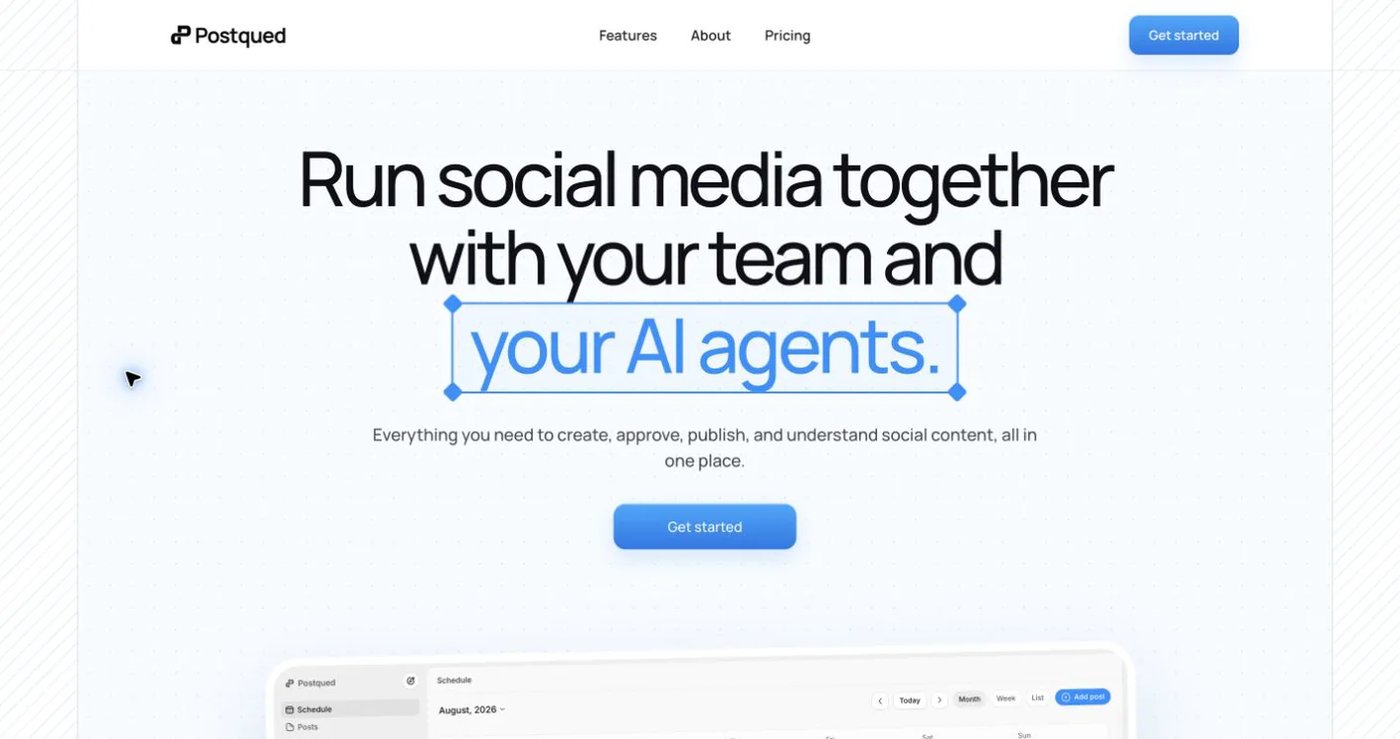
Agencies can use Postqued to schedule TikTok alongside their other client channels from the same workspace. The $49 Pro plan includes 30 connected accounts, unlimited workspaces and seats, approvals, and client review; the $199 Agency plan removes the account limit.
Before choosing a TikTok scheduler, check that it keeps clients separate, gives each person the right access, preserves approval status, and publishes every format in the contract. Then price it at the number of accounts the agency expects to manage.
The best agency TikTok schedulers at a glance
| Product | Best agency fit | Published entry point | Important tradeoff |
|---|---|---|---|
| Postqued | Client workspaces, approvals, and API or MCP automation | Pro: $49/month for 30 accounts; Agency: $199 for unlimited accounts | No CSV importer, TikTok inbox, DMs, listening, white label, sound catalog, or effects editor |
| Buffer | A simple queue with per-channel pricing and unlimited teammates on Team | Free for 3 channels; paid plans are priced per channel | Cost depends on every connected channel; API request limits vary by plan |
| Later | Visual planning, media organization, and external review | Starter: $25/month; Growth: $50/month on monthly billing | Starter has one user; agency collaboration begins on Growth |
| Planoly | Design-led planning and social sets for smaller agencies | $16/month Starter; $28 Growth; $55 Pro on monthly billing | Public pricing does not describe formal client approval stages |
| Hootsuite | Governance, inbox, listening, reporting, and larger operations | Public FAQ lists plans from $99 per user; verify billing selection | Team approvals begin on Advanced; seat and plan costs can be substantial |
These products package accounts differently. Postqued uses connected-account allowances and workspaces. Buffer bills by channel. Later and Planoly use social sets. Hootsuite sells plans per user and varies account capacity by tier. Compare the cost at the number of client accounts and staff you will actually operate.
What should an agency require from a TikTok scheduler?
An agency scheduler should separate clients, restrict publishing authority, preserve feedback and approval history, and show durable delivery status. TikTok support alone is not enough.
Write down whether your agency needs:
- A separate workspace, access group, or calendar for each client
- Internal review before content reaches a client
- Comments, requested changes, revisions, and explicit approval
- Roles that stop the wrong person from publishing to the wrong account
- TikTok video, photo-post, privacy, interaction, and commercial-content controls
- Analytics suitable for the reporting promised in the client contract
- API access for content arriving from another system
- TikTok comment management, direct messages, listening, or ad reporting
- White-label calendars, dashboards, reports, or email
No tool in this list leads on every requirement. Treat absent capabilities as operating constraints rather than minor checklist gaps.
How we evaluated agency fit
We compared six practical areas using current official documentation:
- Client separation: workspaces, social sets, access groups, and connected-account organization.
- Review controls: comments, revisions, approval decisions, roles, and external feedback.
- TikTok publishing: documented direct publishing, supported post formats, and native-posting fallbacks.
- Capacity and cost: accounts, channels, social sets, users, posts, and paid add-ons.
- Automation: public APIs, authentication, request limits, MCP, and documented workflow integrations.
- Service delivery: analytics, engagement, reporting, listening, and other client-facing capabilities.
We did not award a numerical value score. An approval-focused agency and an API-led content operation need different products.
1. Postqued — best for shared client and automation workflows

Postqued fits agencies that want human reviewers and compatible AI agents working inside the same scoped social media workspace. It supports publishing across TikTok, Instagram, Facebook, Threads, LinkedIn, YouTube, X, Pinterest, Mastodon, and Bluesky. TikTok publishing uses the official Content Posting API for videos and photo posts.
The agency workflow includes separate workspaces, collaborators, roles, invitations, revision-aware comments, caption suggestions, change requests, approval decisions, and assigned client reviewers. Approved revisions can then be scheduled or published by a user or automation with the required permissions.
For TikTok, Postqued refreshes the connected creator account’s available privacy settings and video-duration limit. It supports documented interaction and commercial-content controls. It does not promise access to every TikTok creation feature: sounds, effects, trend discovery, and automatic hashtag optimization are outside the current product surface.
Where Postqued fits
- Pro includes 30 connected accounts plus unlimited workspaces and team seats for $49 per month.
- Agency removes the connected-account limit for $199 per month.
- Every paid plan includes unlimited posts, all 10 publishing networks, and API and MCP access.
- TikTok account-post analytics and video metrics are available.
- Publishing requests have durable status rather than disappearing into an untracked queue.
Boundaries agencies should understand
- There is no CSV bulk importer or dashboard bulk-upload workflow. The API supports repeatable pipelines, but each post is created and validated separately.
- The Engagement Inbox covers comments and replies on seven other networks, not TikTok. Postqued also does not provide DMs or social listening.
- Analytics are available for five publishing networks, not all 10.
- There is no white-label dashboard or report.
- Consequential approval and publishing actions remain subject to roles, workspace scope, confirmation, and provider limits.
Read the dated Postqued product facts, TikTok scheduler evidence, pricing, and API documentation before matching the product to a client contract.
2. Buffer — best for a straightforward per-channel team workflow

Buffer is a credible agency option when the team wants a clean queue and prefers to pay for the exact channels it connects. Its Free plan supports three channels with a 10-post queue per channel. Essentials is $6 per channel month to month, while Team is $12 per channel and adds unlimited users, approval workflows, notes, and channel-level access controls.
Buffer’s current public API is available on every plan and supports TikTok posting. Free, Essentials, and Team publish different API-key and request allowances; Team currently lists up to five keys and 15,000 requests per rolling 30-day window. That makes the old claim that Buffer has no agency API incorrect.
Buffer works well when an agency can model its cost channel by channel and wants one familiar publishing queue. Its pricing can still grow as every client adds TikTok plus other networks. API keys are currently owner-managed, and third-party applications use OAuth, so compare that model with your internal security and integration requirements.
Review Buffer pricing, the Buffer API, and its API usage guide.
3. Later — best for visual planning and external feedback
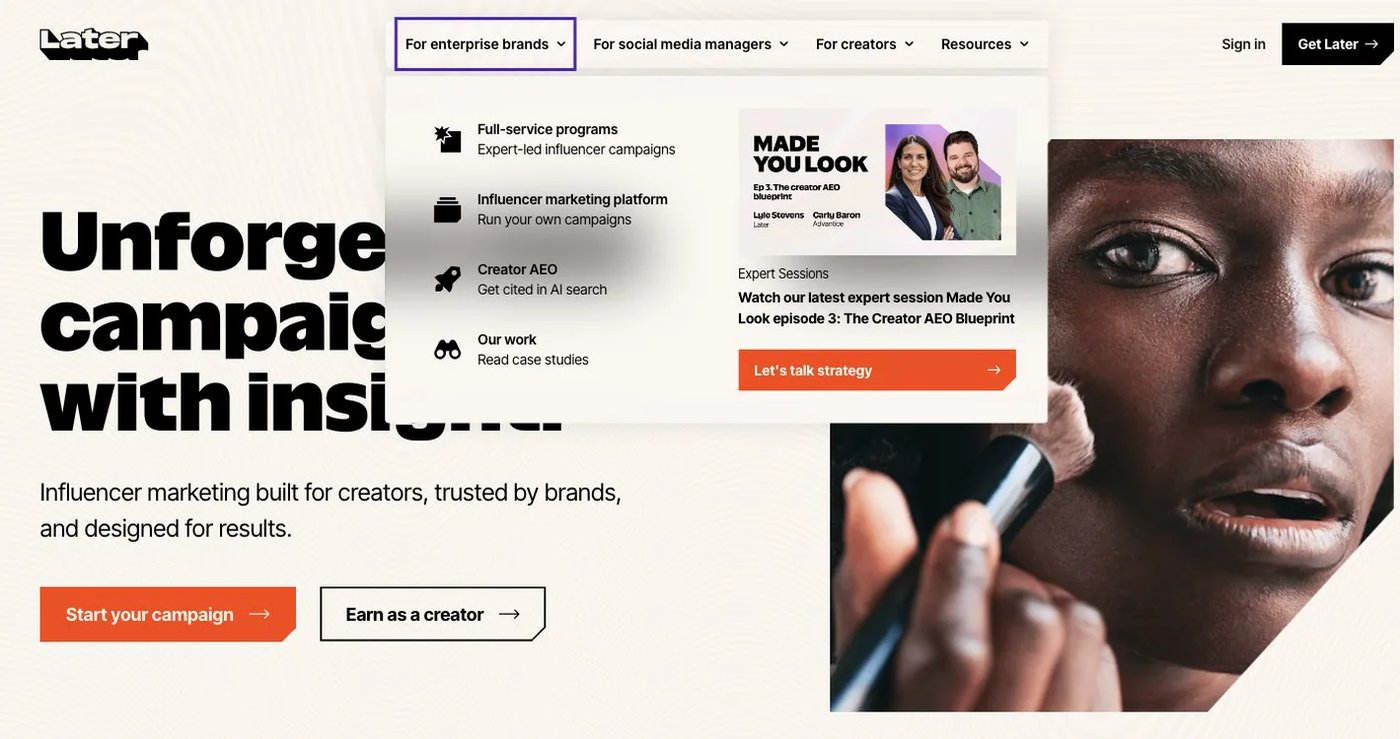
Later is a strong fit for agencies whose workflow starts with visual planning, media organization, and stakeholder review. It auto-publishes supported TikTok posts and offers notification publishing when a team needs to finish a post with native music or stickers.
On monthly billing, Starter is $25 for one social set, one user, and 30 posts per profile. Growth is $50 for two social sets and two users, with additional sets and users available. Growth adds internal and external collaboration, post comments and activity history, content approvals, custom roles, calendar sharing, and a social inbox. Scale is $110 with six social sets, four users, unlimited posts, custom analytics, and broader insight features.
Later therefore deserves consideration for client feedback and brand-specific calendars. It is not accurately described as a one-profile tool with no collaboration. The tradeoff is that the agency must model social sets, users, and post allowances at its projected client count.
Review the current Later pricing and feature matrix.
4. Planoly — best for design-led social planning

Planoly fits smaller agencies that value visual planning, a media library, and a social-set model. Its current pricing page includes TikTok in the Social Planner and says posts can auto-publish when the platform and format allow it, with native-posting reminders when music or editing tools are required. The old claim that Planoly cannot auto-post TikTok at all is too broad.
Month-to-month pricing is $16 for Starter with one social set and one user, $28 for Growth with two sets and two users, and $55 for Pro with six sets and six users. Current plans list unlimited uploads, and Growth and Pro sell additional sets and users. Planoly also lists an MCP integration.
Planoly’s public pricing page does not describe the formal approval depth that Later, Hootsuite Advanced, or Postqued document. Agencies should confirm the exact TikTok format, direct-publishing versus notification workflow, client access, and approval requirement before choosing it for production.
Review Planoly pricing and documented features.
5. Hootsuite — best for governance and broader social operations

Hootsuite fits agencies and larger organizations that need more than a TikTok calendar. Its plans combine publishing with an inbox, monitoring, reporting, listening, and increasing governance controls.
The current public plan page lists Standard with up to 10 social accounts, Professional with unlimited accounts and custom reports, and Advanced with team approvals, assignment, routing, and team-performance measurement. Enterprise adds SSO, advanced analytics, listening, and compliance options. Hootsuite’s FAQ lists starting figures of $99 for Standard, $199 for Professional, and $399 for Advanced, while displayed plan prices can depend on annual or monthly billing. Verify the selected checkout total and seat count rather than relying on an old roundup price.
Hootsuite is the better fit when a client’s contract requires listening, customer care, governance, or enterprise security that Postqued does not provide. It can be excessive when the agency only needs a straightforward TikTok publishing and approval workflow.
Review Hootsuite plans and its external approval documentation.
Agency cost and workflow scenarios
| Scenario | Sensible starting point | Why |
|---|---|---|
| Up to 30 connected accounts, many client workspaces, several staff | Postqued Pro at $49/month | Unlimited workspaces and seats with a fixed 30-account allowance |
| A large account portfolio using the same shared workflow | Postqued Agency at $199/month | Removes the connected-account cap |
| A small channel count with a simple queue and team approvals | Buffer Team | Pay per connected channel and invite unlimited teammates |
| Visual campaigns requiring external comments and approvals | Later Growth | Adds external feedback, approvals, access groups, and post history |
| A design-led agency using social sets | Planoly Pro | Six social sets and six users on the published monthly plan |
| Listening, customer care, and formal governance | Hootsuite Advanced or Enterprise | Broader operational and security capabilities |
This table is not a quote. Taxes, annual discounts, extra users, additional sets, storage, provider charges, and negotiated plans can change the total.
Test one real client workflow before buying
Run the same controlled campaign through every finalist:
- Create two client environments and connect test TikTok accounts through the official authorization flow.
- Invite a creator, editor, account manager, and client reviewer without sharing credentials.
- Upload one video and one photo post, then inspect the available creator-specific publishing options.
- Request a caption change, create a revision, and verify exactly which version is approved.
- Schedule the approved post and inspect publishing status, failure information, and retry handling.
- Export or present the TikTok analytics promised in the client agreement.
- Test any API or agent workflow with production-equivalent permissions and a non-critical account.
- Calculate the price at today’s account count and the expected count 12 months from now.
This exposes the difference between a feature appearing on a plan page and a workflow the agency can safely deliver.
Final recommendation
Choose Postqued when your agency wants predictable account bundles, unlimited workspaces and team seats on Pro or Agency, revision-aware approval and client-review workflows, and API or MCP automation. Choose Buffer when a per-channel queue and simple team controls fit the portfolio, Later when visual planning and external feedback lead the process, Planoly when design and social sets matter most, or Hootsuite when listening, customer care, governance, and enterprise controls justify the cost.
Do not choose on account count alone. Verify the exact TikTok formats, access controls, approval record, reporting coverage, and total client cost before moving a production calendar.
Official sources reviewed
- Postqued pricing, product facts, TikTok scheduler, MCP workflow, and API documentation
- TikTok Content Posting API direct-post reference, photo-post reference, and content-sharing guidelines
- Buffer pricing, API overview, and API usage guide
- Later pricing and feature matrix
- Planoly pricing and documented features
- Hootsuite plans and external approvals
Managing more than TikTok? Read the broader social media management software for agencies comparison.