Best Social Media Scheduler for Developers in 2026: 5 API Options

Developers can use Postqued as a hosted social publishing API instead of building account connections, scheduling, and delivery tracking themselves. Connect accounts in the dashboard, then use one API key for your organization to schedule posts across 10 networks and track each job until it succeeds or fails.

This guide compares five products that document programmatic post creation: Postqued, Post for Me, Ayrshare, Postiz, and Buffer. We look at what each API can do, how it handles accounts and authentication, how publishing status is reported, whether it can be self-hosted, which networks it supports, and what it costs.

Quick comparison

Tool Developer surface Authentication Delivery status Best fit Current entry point
Postqued REST API v2 and remote MCP Organization-bound API key Poll durable publish records Teams combining a dashboard, approvals, API, and agents $9/month, 7-day trial
Post for Me REST API, SDKs, MCP API key Customer webhooks available Embedding nine-network publishing in a product $10/month for 1,000 successful posts
Ayrshare Full-stack social API API key and customer-profile model Webhooks on relevant plans SaaS products managing customer social profiles at scale $149/month for one profile
Postiz REST API, CLI, MCP, self-hosting API key or OAuth2 Webhooks documented Open-source control or broad channel coverage $29/month hosted; self-host option
Buffer GraphQL API API key or OAuth2 with PKCE Retrieve scheduled, sent, and draft posts Existing Buffer users and GraphQL integrations API access on Free and paid plans

Prices are monthly list prices shown by each vendor on August 9, 2026. “Profile,” “channel,” “account,” and “successful post” are different billing units; do not compare the headline prices without modeling your actual usage.

What developers should evaluate

1. Whose accounts will the integration control?

A personal API key is appropriate for a trusted backend acting inside one organization. A multi-tenant application needs a delegated authorization flow or a vendor-managed customer-profile model. Avoid collecting another user’s personal API key when the provider offers OAuth for third-party applications.

2. Can the API express each platform’s settings?

“Create a post” is only the starting point. TikTok privacy and interaction settings, Pinterest boards, YouTube metadata, Instagram post types, and network-specific media limits still matter. Compare the exact formats and settings your application needs, not only the platform count.

3. How does delivery state work?

Publishing is asynchronous. Your application needs a durable identifier, clear terminal states, retry-safe creation, and either polling or customer-facing webhooks. Do not assume a vendor offers outbound webhooks because it uses provider webhooks internally.

4. What are the safety boundaries?

Look for scoped credentials, revocation, idempotency, dry-run validation, explicit workspace or tenant boundaries, and documented error behavior. Long-lived API keys reduce token-refresh work, but they are secrets—not permanent credentials to forget about. Store them in a secrets manager, rotate them after exposure, and revoke unused keys.

5. What does the price meter?

Vendors charge by connected channel, customer profile, successful post, plan allowance, or infrastructure you operate yourself. Calculate a realistic month with expected customers, connected accounts, posts, API calls, seats, and support requirements.

1. Postqued — best for a shared workspace plus REST API and MCP
Postqued official website

Postqued is a shared social media workspace where teams and AI agents plan content, work through approvals, and publish across 10 networks using the dashboard, API, or remote MCP server. It is not TikTok-only, and the API does not replace the visual product: both surfaces operate on the same organization- and workspace-scoped data.

The public publishing workflow is explicit. Create an organization-bound API key, connect social accounts through the dashboard, upload media, validate the exact request with dryRun: true, then publish with a unique Idempotency-Key. Clients track the durable publish record with GET /v2/publish/{publishId} until its targets complete or fail. See the five-step workflow and API v2 documentation.

Where Postqued is strong

  • Publishing supports TikTok, Instagram, Facebook, Threads, LinkedIn, YouTube, X, Pinterest, Mastodon, and Bluesky.
  • API and remote MCP access are included on every paid plan.
  • Machine requests use an organization-bound bearer key and require an explicit workspace for workspace-scoped routes.
  • Dry-run validation and idempotency support safer publishing and retries.
  • The 62-action MCP catalog extends beyond publishing into approvals, suggestions, engagement, collaboration, and client review.
  • Teams can use the dashboard and calendar while backend jobs or compatible agents use the same workspace.

Important limits

  • Postqued does not currently document customer-configurable outbound publishing webhooks. API clients should poll the publish-status endpoint.
  • Social accounts are connected interactively through the dashboard before the API or MCP server uses them.
  • Analytics cover TikTok, Facebook, Instagram, Threads, and YouTube—not all 10 publishing networks.
  • The Engagement Inbox covers comments and replies on seven networks; it does not include direct messages or social listening.
  • API keys are revocable credentials. Treat them as secrets and rotate them when necessary.

Postqued starts at $9/month for five connected accounts. Every paid plan includes all 10 publishing networks, unlimited posts, API access, and MCP access. Pro and Agency add unlimited workspaces and team seats. See the current Postqued pricing.

Choose Postqued when: your team needs one operational workspace for dashboard users, backend integrations, approvals, and AI-agent workflows.

Choose another option when: you need customer-facing OAuth into a third-party scheduler, outbound status webhooks, direct messages, social listening, or self-hosting.

2. Post for Me — best for a focused, embeddable posting API

Post for Me official website

Post for Me is designed for developers adding social publishing to their own application. Its official materials list a unified REST API across nine platforms, SDKs, post and account webhooks, feeds, analytics, and both quick-start and white-label connection models.

The product starts at $10/month for up to 1,000 successful posts and includes unlimited social accounts, projects, team members, and API keys. That usage-based model is easy to understand for a product with modest posting volume, but you should model how the bill changes as successful posts grow.

Post for Me also documents customer webhooks for post and account events, including retries and a shared webhook secret. This is a meaningful difference from Postqued’s current polling model.

Choose Post for Me when: you want an embeddable API, SDKs, customer webhooks, and a post-volume price meter.

Look closely at: platform-specific format coverage, your projected successful-post volume, and whether quick-start vendor credentials or white-label developer credentials fit your customer experience.

3. Ayrshare — best for customer-profile infrastructure
Ayrshare official website

Ayrshare is a mature social API aimed at products, platforms, agencies, and multi-location businesses. Its billing unit is a social profile: one customer, brand, or location can connect multiple networks inside that profile.

The $149/month Premium plan covers one social profile. Launch costs $299/month for up to 10 profiles, while Business starts at $599/month with 30 profiles and tiered pricing beyond that. Official pricing lists 13-plus networks, unlimited scheduled posts, analytics, moderation, and broader customer-facing infrastructure. Webhook integrations are listed from Launch upward.

This makes Ayrshare materially different from a low-cost team scheduler. Its higher starting price buys a profile abstraction designed for applications managing external users, along with functionality such as comments, direct messages, and reviews where supported.

Choose Ayrshare when: you are embedding social capabilities for customers and need profiles, moderation, messaging, analytics, and scale under one API vendor.

Look closely at: which plan permits acting for external customers, active-profile billing, messaging charges, network-specific limits, and the webhook features included in your tier.

4. Postiz — best for open-source and self-hosted control
Postiz official website

Postiz offers a hosted scheduler and an open-source self-hosted path. Its public REST API accepts an API key for a user’s own account and OAuth2 when an application acts on behalf of other Postiz users. It also documents a CLI, MCP server, post creation, platform-specific settings, and webhooks.

Hosted Standard costs $29/month for five channels with unlimited posts, API access, and webhooks. The public API documentation describes broad platform coverage and a create-post limit of 100 requests per hour on Postiz Cloud, with multiple posts allowed in one request.

Self-hosting can reduce vendor dependence and provide infrastructure control, but it does not eliminate operational cost. The official deployment documentation calls for Postgres, Redis/Temporal-related services, persistent media storage, outbound access to provider APIs, upgrades, backups, monitoring, and your own platform app configuration.

Choose Postiz when: source access, self-hosting, broad channels, or supporting both API keys and third-party OAuth matters most.

Look closely at: infrastructure ownership, platform app approvals, cloud versus self-host behavior, rate limits, upgrade work, and which features require hosted services.

5. Buffer — best for a dashboard-first GraphQL API
Buffer official website

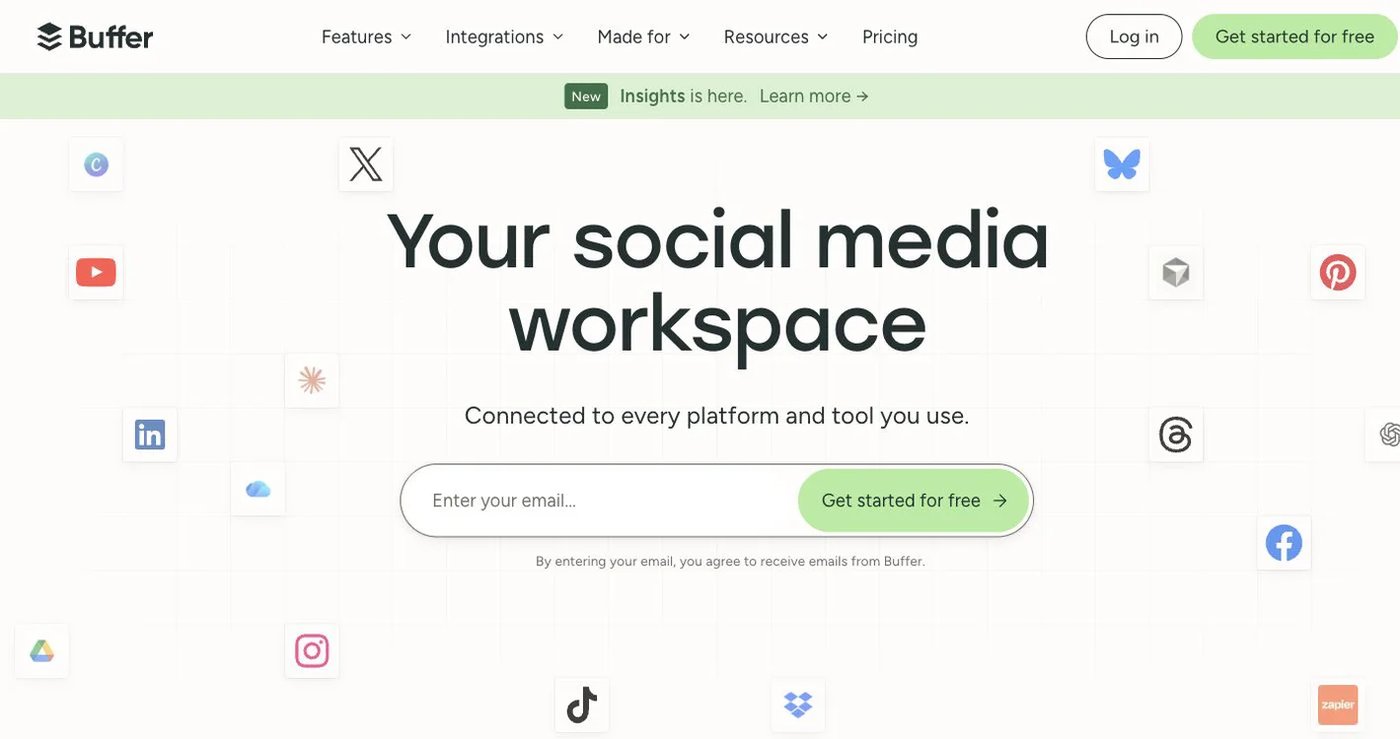
Buffer’s current API is no longer read-only. Its official developer portal documents a GraphQL API that can create and schedule text and image posts, delete posts, manage content ideas, and retrieve organizations, channels, drafts, scheduled posts, and sent posts.

Developers can use an account API key for their own Buffer account or OAuth2 with PKCE for applications acting on behalf of other users. API access is available on the Free, Essentials, and Team plans. Current 30-day request limits are 3,000, 7,500, and 15,000 per client, respectively, with additional rolling 15-minute and 24-hour limits.

The main trade-off is scope. Buffer is a dashboard-first publishing product with per-channel pricing and a GraphQL API, not a profile-based social infrastructure service. Personal API keys are user-based and can access all organizations available to that user; use organization IDs carefully.

Choose Buffer when: your users already work in Buffer, GraphQL fits your stack, or you want free API access for a smaller internal integration.

Look closely at: media and platform support in the current mutations, request quotas, per-channel pricing, key scope, OAuth refresh-token handling, and whether the API exposes every dashboard feature you need.

API key or OAuth: the practical decision

Use a personal or organization API key when a trusted server controls accounts owned by the same business. This is the simpler model for cron jobs, internal services, CI tasks, and one organization’s agent workflows.

Use OAuth when your product connects accounts owned by many independent customers. OAuth gives users a consent screen and a revocation path without asking them to paste personal credentials into your product. It adds token storage and refresh handling, but that complexity is appropriate for delegated access.

Remember that scheduler authentication and social-network authentication are separate layers. Even when your backend calls a scheduler with one API key, account owners still have to authorize Instagram, TikTok, LinkedIn, and other networks through the provider-approved connection flow.

Final recommendation

Match the API to the product you are building:

  • Choose Postqued for a combined team workspace, 10-network scheduler, scoped REST API, approvals, and a broad MCP surface.
  • Choose Post for Me for a focused embeddable API with SDKs, webhooks, and usage-based pricing.
  • Choose Ayrshare for customer-profile infrastructure, moderation, messaging, and larger embedded-product programs.
  • Choose Postiz when open-source code, self-hosting, broad channels, and OAuth flexibility outweigh operational work.
  • Choose Buffer for a mature dashboard with a current write-capable GraphQL API and plan-based quotas.

Before committing, prototype the hardest platform-specific post your product needs. Test account connection, media upload, validation errors, asynchronous status, retries, revocation, and the exact billing unit. A successful “hello world” request is useful; a realistic failure-and-recovery test is what tells you whether an API fits production.

Sources and verification date

Checked August 9, 2026:

Frequently Asked Questions

What is the best social media scheduler for developers?

The best option depends on the product you are building. Postqued fits teams that want a shared scheduling workspace plus REST API and MCP access. Post for Me and Ayrshare are designed for embedding social capabilities into customer-facing products. Postiz adds open-source self-hosting, while Buffer offers a GraphQL API alongside its established dashboard.

Does Postqued have a social media publishing API?

Yes. Postqued's v2 REST API supports organization- and workspace-scoped content, publishing, status, analytics, engagement, and collaboration workflows. API and MCP access are included on every paid plan. Publishing covers 10 networks; analytics and engagement have narrower documented coverage.

Does Postqued send publishing-status webhooks to customer endpoints?

Postqued does not currently document customer-configurable outbound publishing webhooks. After publishing or scheduling through API v2, clients should poll the durable publish-status endpoint until each target reaches a terminal state.

Should I use an API key or OAuth for a social media integration?

Use a revocable API key for trusted server-side automation within your own account or organization. Use OAuth when your application must let many external customers authorize access to their own scheduler accounts. Never expose either credential in browser code or commit it to source control.

Can AI agents use Postqued?

Yes. Compatible agents can connect to Postqued's remote MCP server with an organization-bound API key. The current catalog covers 62 actions across workspaces, accounts, content, publishing, analytics, engagement, approvals, suggestions, collaboration, and client review. Permissions, validation, approvals, and provider limits still apply.

Is there an open-source social media API in this comparison?

Postiz is open source and can be self-hosted. Its public API supports API-key authentication for your own account and OAuth2 for applications acting on behalf of other Postiz users. Self-hosting adds responsibility for infrastructure, upgrades, storage, queues, security, and platform credentials.