7 Best RecurPost Alternatives in 2026
Postqued is the best RecurPost alternative for most teams: unlimited posts on 10 platforms, revision-aware approvals, and REST API plus MCP access on every plan from $9/month, with a 7-day free trial. For the same $9 RecurPost charges for two accounts, Postqued Solo connects five.
RecurPost still wins when an evergreen library must republish itself automatically.
What are the best RecurPost alternatives?
| Tool | Starting price | Best for | Repeating posts | Developer access |
|---|---|---|---|---|
| Postqued | $9/month | Approvals and API or agent automation | No | REST API and MCP |
| OneUp | $25/month | Repeating posts | Yes | API and MCP |
| Postiz | $29/month hosted | Open-source control | Yes, per post | API, MCP, webhooks |
| Post Bridge | $39/month | Lightweight multi-platform publishing | Not its focus | API included |
| PostPlanify | $99/month | Approvals, inbox, and reports | Queue time slots | API and MCP on supported plans |
| SocialBee | $29/month | Category-based evergreen queues | Yes, by category | No public API |
| MeetEdgar | $29.99/month | Self-filling weekly category slots | Yes, by category | No public API |
How much does RecurPost cost?
RecurPost’s pricing page lists four tiers:
- Starter: $9/month for two social accounts and one user.
- Personal: $25/month for five accounts and one user.
- Agency: $79/month for 20 accounts and three users, with client workspaces, approvals, and white-label reports.
- Enterprise: custom pricing for 100+ accounts.
- Add-ons: extra accounts $4/month; extra team members $20/month.
- Billing: annual plans give two months free. No free plan; a 14-day trial needs no credit card.
1. Postqued: best for API and AI-agent scheduling

Postqued gives you more accounts per dollar than RecurPost plus developer automation on every plan. Scripts and AI agents publish through the REST API and a 62-tool MCP server. The Publish API supports dryRun validation, an Idempotency-Key header for real publishes, and dispatchAt scheduling.
Approvals are revision-aware, so the approved snapshot is what publishes, and you can invite external reviewers by email. The Engagement Inbox handles comments and replies on Facebook, Instagram, Threads, X, LinkedIn, and Mastodon. Analytics cover TikTok, Facebook, Instagram, Threads, and YouTube, and formats include Instagram Stories and Reels and TikTok photo posts up to 35 images.
Solo covers 5 accounts for $9/month against RecurPost Personal at $25. Creator covers 20 accounts for $29 against RecurPost Agency at $79, Pro covers 30 with unlimited seats for $49, and Agency at $199 removes the account cap. Yearly billing lowers Solo, Creator, Pro, and Agency to $7, $19, $39, and $159. Every plan includes unlimited posts on TikTok, Instagram, YouTube Shorts, Facebook, LinkedIn, Pinterest, Threads, Bluesky, Mastodon, and X, plus a 7-day free trial.
Postqued does not recycle evergreen posts automatically, but an agent can reschedule proven posts through the API.
See Postqued pricing or compare Postqued vs RecurPost.
2. OneUp: best for repeating posts
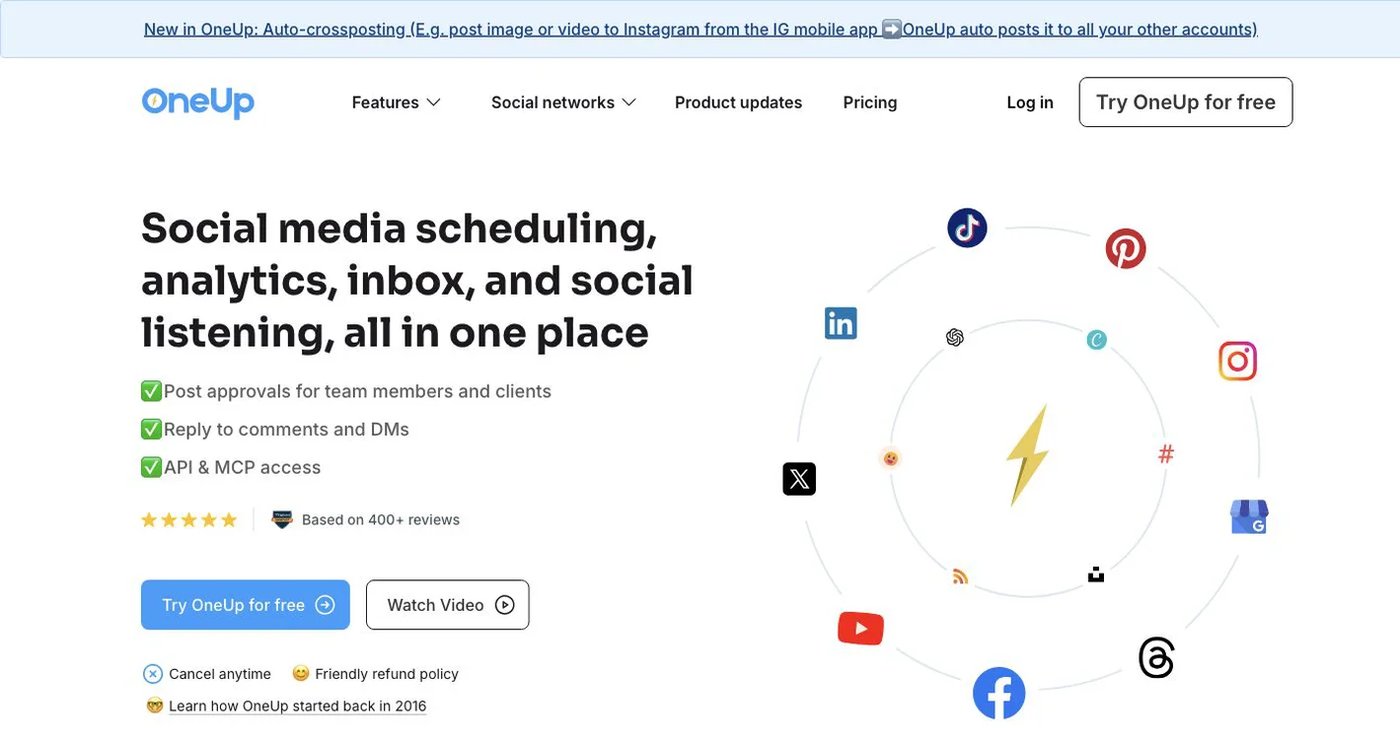
OneUp is the closest small-tool replacement for RecurPost’s recycling. It repeats individual posts, runs repeating queues, and publishes across major networks.
It supports bulk upload from CSV, Google Sheets, Google Drive, Dropbox, or local files, plus an inbox, listening, reports, and client approvals. API and MCP access come on every paid plan.
The $25/month entry plan includes five accounts and up to 300 scheduled posts. Unlimited scheduled posts and video bulk upload start on the $60/month Intermediate plan.
Choose it when posts must repeat automatically and you want an inbox in the same tool. See OneUp pricing.
3. Postiz: best for open-source control

Postiz offers a hosted scheduler and an open-source codebase you can self-host. Individual posts can repeat on a schedule.
Its pricing page lists Standard at $29/month ($23 billed yearly) for 5 channels, Team at $39 for 10 channels with unlimited team members, Pro at $49 for 30, and Ultimate at $99 for 100. Every hosted plan includes unlimited posts, the public API, MCP, a CLI, and webhooks.
Self-hosting means your team owns updates, uptime, storage, and each network’s developer app. Code lives on GitHub.
Choose it when self-hosting or code access matters most.
4. Post Bridge: best for a lightweight publishing workflow
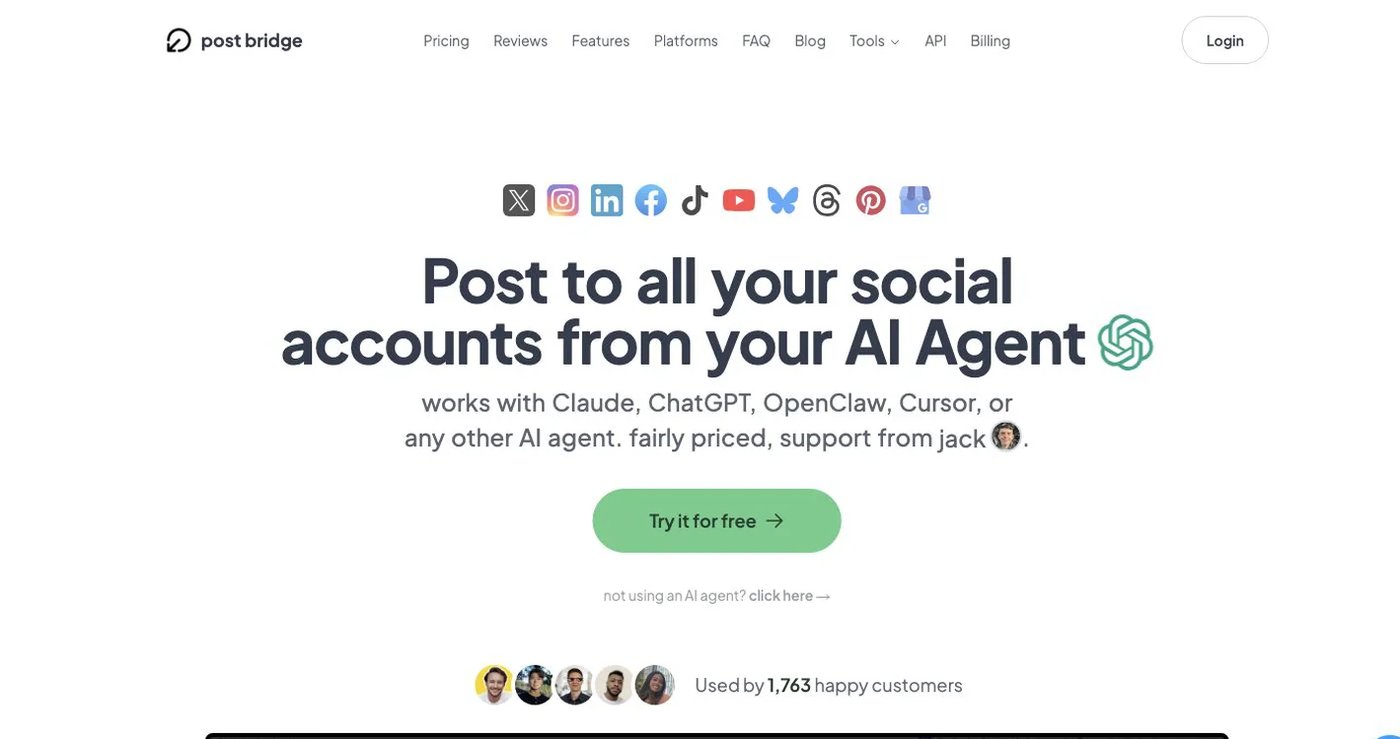
Post Bridge is a simple multi-platform scheduler with unlimited post scheduling and API access included.
Its pricing page lists Marketer at $39/month for 15 connected accounts, built for one person marketing a business. Operator costs $99/month for 99 accounts, then $1 per extra account, and adds team member invitations. Yearly billing gives two months free.
It has a smaller feature surface than full social suites. See its API reference.
Choose it when you want a plain scheduler with API access and many accounts.
5. PostPlanify: best for team approvals and an inbox

PostPlanify combines scheduling, approvals, analytics, an inbox, reports, and multiple workspaces. It bulk schedules up to 20 posts in its calendar and publishes across 10 platforms.
Growth costs $99/month, or $79/month billed annually, for 15 social accounts, five workspaces, and three team members. It includes shared calendars, roles, post comments, and a media library.
It is not a budget option; its value is replacing several team tools.
Choose it when an agency needs approvals, inbox, and reports in one product. See PostPlanify pricing and its help center.
6. SocialBee: best for category-based recycling

SocialBee is the closest match to RecurPost’s libraries if you think in categories. Each category, such as tips, promotions, or testimonials, gets its own posting schedule, and evergreen posts rotate through it. RSS sources, post variations, and expiry dates keep the rotation from going stale.
Bootstrap is $29/month for five profiles and one user. Accelerate is $49 for 10 profiles and adds approvals and CSV uploads, and Pro is $99 for 25 profiles and five workspaces. SocialBee’s help center says it has no public API. See SocialBee pricing.
Choose it when you want RecurPost-style recycling with more control over the content mix.
7. MeetEdgar: best for a self-filling weekly queue

MeetEdgar fills recurring weekly time slots from your content categories, so a library keeps publishing once it is set up. It supports RSS and spreadsheet imports, variations, and random slots, and it publishes to TikTok, Instagram, X, Threads, LinkedIn, Facebook, Pinterest, and Google Business Profile.
Eddie costs $29.99/month for five accounts, four categories, and 10 weekly automations. Edgar costs $49.99 for 25 accounts, unlimited categories, and 1,000 weekly automations. Both allow 20 team members, and the trial lasts 30 days. See MeetEdgar pricing.
Choose it when you want the most hands-off evergreen queue and your team is larger than RecurPost’s user limits allow.
How do you choose a RecurPost alternative?
- Decide whether automatic recycling is required or optional.
- Count your accounts and users, then price each tool at that size.
- List the post formats you publish and test each one.
- Confirm API or MCP access on the plan you would buy.
- Rebuild future posts and reconnect accounts in the new tool.
- Keep RecurPost active until a test batch publishes.
Which RecurPost alternative should you choose?
Postqued is the right pick for most teams: five accounts, unlimited posts, approvals, and API plus MCP access from $9/month. Choose OneUp, SocialBee, or MeetEdgar if posts must repeat automatically, Postiz for self-hosting, Post Bridge for a plain scheduler, and PostPlanify for an agency suite.
Primary sources
- RecurPost pricing
- OneUp pricing and features
- Postiz pricing and open-source repository
- Post Bridge pricing and API reference
- PostPlanify pricing and help center
- SocialBee pricing
- MeetEdgar pricing
Get five accounts for RecurPost’s $9 entry price on Postqued Solo, starting with a 7-day free trial: See Postqued pricing.